











































































































This product is an open source software. If you would like to access the source code, please visit the below link. (You do not need to click "ADD TO CART" for this item)
<<To ACCESS Source Code: CLICK HERE>>
Authors: Prof. Qifeng Chen, Chen Chen, Minh N. Do and Vladlen Koltun
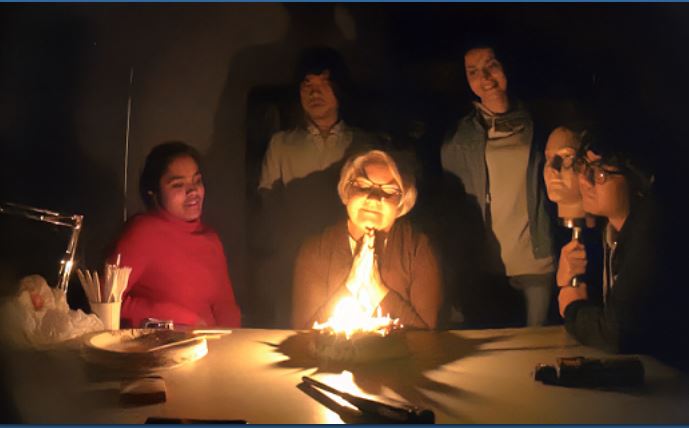
Deep learning has recently been applied with impressive results to extreme low-light imaging. Despite the success of single-image processing, extreme low-light video processing is still intractable due to the difficulty of collecting raw video data with corresponding ground truth. Collecting long-exposure ground truth, as was done for single-image processing, is not feasible for dynamic scenes. In this paper, we present deep processing of very dark raw videos: on the order of one lux of illuminance. To support this line of work, we collect a new dataset of raw low-light videos, in which high-resolution raw data is captured at video rate. At this level of darkness, the signal-to-noise ratio is extremely low (negative if measured in dB) and the traditional image processing pipeline generally breaks down. A new method is presented to address this challenging problem. By carefully designing a learning-based pipeline and introducing a new loss function to encourage temporal stability, we train a siamese network on static raw videos, for which ground truth is available, such that the network generalizes to videos of dynamic scenes at test time. Experimental results demonstrate that the presented approach outperforms state-of-the-art models for burst processing, per-frame processing, and blind temporal consistency.
Authors:
Department of Computer Science and Engineering Assistance Professor Prof. Qifeng Chen
Key Features:
The model was trained on static videos only but was shown to generalize to dynamic videos. Quantitative and qualitative results demonstrate that our method achieves superior performance over a range of baselines, particularly in the more extreme low-light scenarios.
Specification:
Please check on the attached file for the published paper
Reference:
https://cqf.io/papers/Seeing_Motion_In_The_Dark_ICCV2019.pdf
Contact Us:
Download (1)
Seeing Motion In the Dark
Seeing_Motion_In_The_Dark_ICCV2019.pdf*
size: 7580446 KB, type: application/pdf
You would be able to download the files marked with an asterisk '*' only after logging in to your account and completing the purchase of the product license.
This is an open source software developed by The Hong Kong University of Science and Technology (HKUST).
Users shall be responsible for compliance with all the terms of the applicable licenses for the use of open source software including the terms as set forth by Github. Users shall be solely liable for any breaches of such terms and agree to hold harmless and fully indemnify HKUST and its subsidiary including Hong Kong University of Science and Technology R and D Corporation Limited (RDC) for any losses, claims, liabilities, damages, awards, penalties, or injuries (including reasonable attorney’s fees) against and cause to HKUKST and RDC arising from Users’ breach of such terms.
Please access the link to the open source code in Github for further license information.